
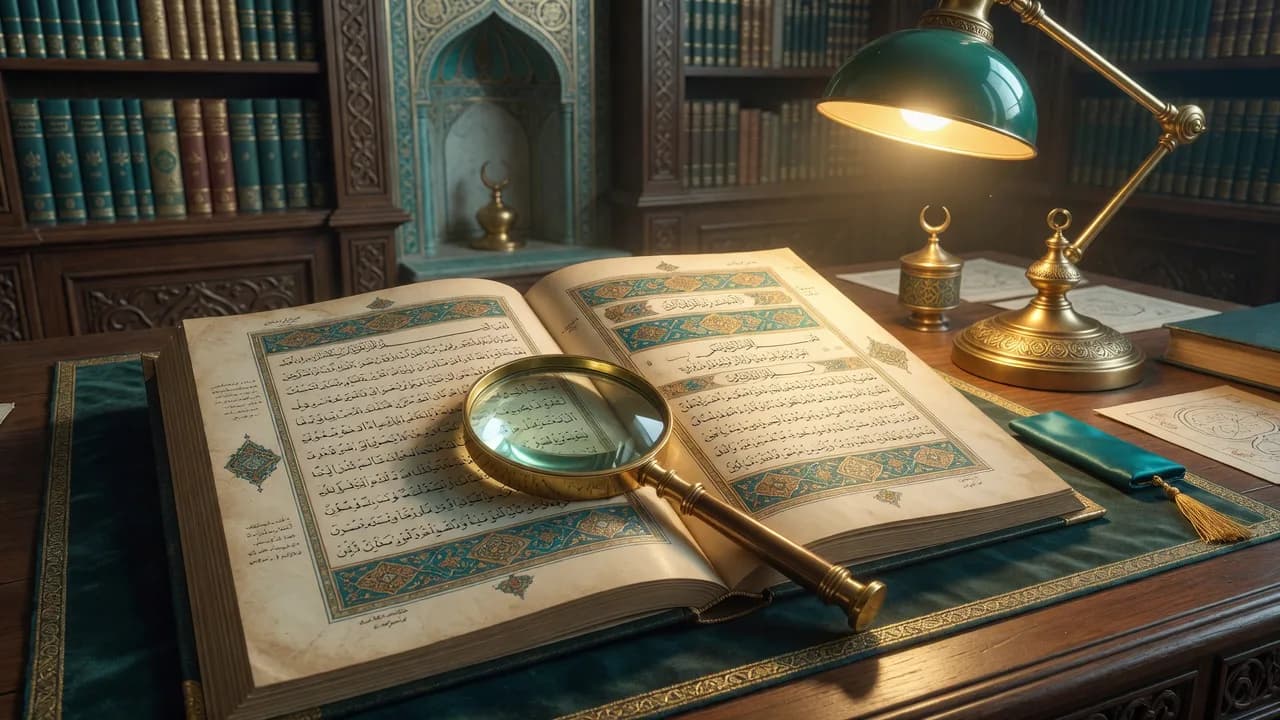
The primary sources of classical Islamic sciences are written in Arabic; however, for the vast majority of students pursuing knowledge in Turkey, the mother tongue is Turkish. This reality necessitates establishing a delicate balance between Arabic and Turkish in the process of reading texts. On one hand, the student must develop Arabic language skills, and on the other, utilize Turkish commentaries and translation resources to understand the text. DİDAR Academy's four-year curriculum manages this balance with a gradual and conscious strategy. Every stage skipped in haste leads to serious reading difficulties in subsequent years.
The first year of the DİDAR curriculum is entirely dedicated to Arabic preparation. During this period, students practice reading Arabic directly with texts such as Majmūʿat al-Ṣarf, Awāmil, Tuḥfat al-Saniyyah, and Qaṣaṣ al-Nabiyyīn. Turkish resources are used only at a supplementary level at this stage; the main focus is the Arabic text itself. This approach ensures that the student acquires the necessary linguistic foundation before moving on to more advanced texts like Tabarī, Bukhārī, and Sarakhsī in the second year. Skipping or lightening the Arabic preparation period leads to excessive reliance on Turkish commentaries.
In the second year, the text reading process adopts a three-layered structure. The first layer is the original Arabic text; the student reads and tries to understand the text with the instructor during class. The second layer is the instructor's explanation; the context of the text, difficult words, and jurisprudential or exegetical inferences are explained in Turkish. The third layer involves the student consulting dictionaries and, if necessary, Turkish commentary texts during individual study. The balance of these three layers ensures that the student both develops Arabic skills and correctly understands the text.
The role of Turkish commentaries and translation resources must be clearly defined. They serve as a bridge for students whose Arabic proficiency is not yet developed, but they are not a permanent solution. At DİDAR, students are taught the principle: first look at the Arabic text, search for unfamiliar words in a dictionary, and if still unclear, consult a commentary. This sequence prevents students from rushing to Turkish resources and skipping the text. Over time, students reduce their need for commentaries and engage directly with the original text. This transition is an indicator of the maturity stage of seeking knowledge.
The balance strategy differs across various fields of Islamic sciences. In Qur'anic exegesis texts, chains of narration and linguistic subtleties necessitate Arabic reading; in Islamic jurisprudence texts, understanding the structure of rulings and their justifications can be supported by Turkish explanations of usul (principles of Islamic jurisprudence). In Hadith studies, the reading of the isnad (chain of narrators) and matn (text) is done in Arabic; jurisprudential inferences are discussed in Turkish during deliberations. The DİDAR curriculum applies a balance model appropriate to the character of each discipline. Students learn not the same method for all fields, but the appropriate method for each field.
Study hours are the most critical time when the Arabic-Turkish balance is reinforced. During individual study sessions held daily at DİDAR, students confront the text alone. Consulting Turkish resources is not forbidden during this process; however, students must first exert their own effort. In discussion sessions, students explain what they have understood to their peers in Turkish. This explanation process is the most effective practice for transitioning from the Arabic text to Turkish expression. Students both read the text in Arabic and explain it in Turkish; the bridge between the two languages is thus strengthened.
In the third and fourth years, the balance shifts predominantly towards Arabic. Texts such as Rāzī's Mafātīḥ al-Ghayb, Ibn ʿĀbidīn's Radd al-Muḥtār, and Quṣhayrī's Laṭāʾif al-Ishārāt require a high level of Arabic proficiency. At this stage, Turkish commentaries are used only in exceptional circumstances. By the end of four years, DİDAR students become largely capable of reading classical texts in Arabic; Turkish resources then become tools consulted for in-depth research and comparative study.
In conclusion, the Arabic-Turkish balance in reading classical texts is one of the most sensitive issues in the pursuit of knowledge. DİDAR Academy's gradual curriculum first grounds the student in Arabic, then deepens their understanding with Turkish-supported reading, and finally prepares them to confront the original text directly. Establishing this balance correctly provides both language skills and scholarly depth. On the path of knowledge, Turkish is not an obstacle but a window opening to Arabic; the student who learns to look through the window enters through the door and meets the text itself.