
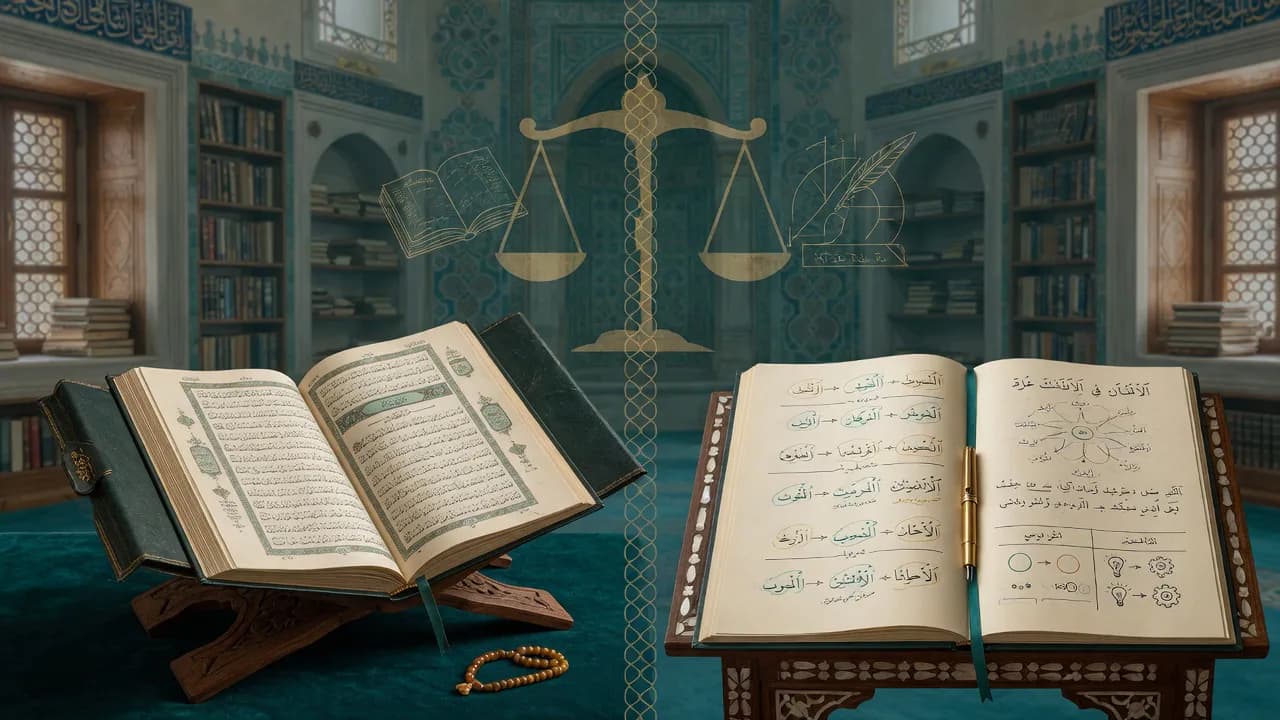
In the pursuit of Islamic sciences, memorization and comprehension are often presented as opposing concepts. On one side, there is an approach that rejects memorization, emphasizing only comprehension; on the other, a memorization approach that neglects comprehension, relying on blind repetition. However, in the Islamic scholarly tradition, memorization and comprehension are not enemies but two complementary elements. DİDAR Academy's educational model consciously establishes this balance, equipping students with lasting learning skills.
The place of memorization in Islamic sciences education is undeniable. Arabic morphology (sarf) and syntax (nahiv) rules, important Hadith, Qur'anic verses, and fundamental concepts are internalized through memorization. The tradition of memorizing the Qur'an (hafızlık) is one of the most magnificent examples of memorization. However, when memorization is detached from comprehension, it turns into a mass of information that is quickly forgotten or misapplied. At DİDAR, memorization is applied as a conscious study method supported by individual study (mütalaa) and discussion (müzakere); the student knows what they are memorizing and grasps the reason behind it.
The role of comprehension, however, is to go beyond memorization. When a student memorizes a nahiv rule, they should see that rule applied in text structures. When they memorize a Hadith, they should also learn its chain of transmission (sanad) and its jurisprudential implications (fıkhî karşılığı). When they memorize a verse, they should study its meaning and its exegetical dimension (tefsir boyutu). In the DİDAR curriculum, Qur'anic exegesis, Hadith studies, and Islamic jurisprudence courses run in parallel; students find opportunities to contextualize the information they memorize across different disciplines.
The practical application of the balance between memorization and comprehension is seen in the mütalaa-müzakere discipline. The student first reads and understands the text through individual study (mütalaa); then memorizes the important points; finally, reinforces the information by discussing it with a discussion group (müzakere). This three-stage process eliminates blind repetition. In DİDAR's four-year curriculum, there is a ten-credit Mütalaa-Müzakere course every semester; this demonstrates the central position of this balance in the curriculum.
The balance between memorization and comprehension is particularly critical in Qur'an education. In the first year of the DİDAR curriculum, students memorize short surahs; at the same time, they study the verses of Surah Al-Baqarah with their meanings. Tajwid and recitation skills are developed alongside comprehension. Students who are memorizers of the Qur'an (hafız) deepen their memorization by also studying the exegesis of the surahs they have memorized. Instead of merely reciting or merely understanding the Qur'an, addressing both dimensions together is fundamental to DİDAR's holistic approach.
The balance between memorization and comprehension also encompasses the dimension of ethics and moral development. Conscious memorization instills patience and consistency in the student; comprehension, on the other hand, develops critical thinking and a sense of responsibility. Before a student applies a memorized Hadith to their life, they must know its meaning and context; otherwise, knowledge does not translate into action. Among DİDAR Academy's aims and objectives is
For students of faculties of theology and high school students, this balance directly affects academic success. A student who prepares for an exam only through memorization may get good grades in the short term; however, they experience knowledge loss in the long term. A student who works based on comprehension, on the other hand, builds lasting knowledge both in exams and in their scholarly journey. DİDAR's Academic Support program observes this balance in its Theology Support and Exam Preparation studies.
The memorization-comprehension balance is also seen in morphology (sarf) and syntax (nahiv) education. Memorizing verb conjugations (fiil babları) is important; however, applying these conjugations in text transforms memorization into comprehension. At DİDAR, the memorization of Mecmûatü's-Sarf is supported by reading the text of Kasasun Nebiyyin. The student both memorizes the rule and sees the rule's application in the text; this dual process is the foundation of lasting learning.
In conclusion, memorization and comprehension are the two wings of lasting learning. Sacrificing one for the other creates an incomplete and fragile structure in the pursuit of Islamic sciences. DİDAR Academy provides this balance at an institutional level through its mütalaa-müzakere discipline, book analyses, scholarly seminars, and a four-year systematic curriculum. The student falls neither into the trap of blind memorization nor superficial comprehension; they acquire a conscious, deep, and lasting body of knowledge. The secret to permanence in the scholarly journey is to be able to carry out memorization and comprehension together.