
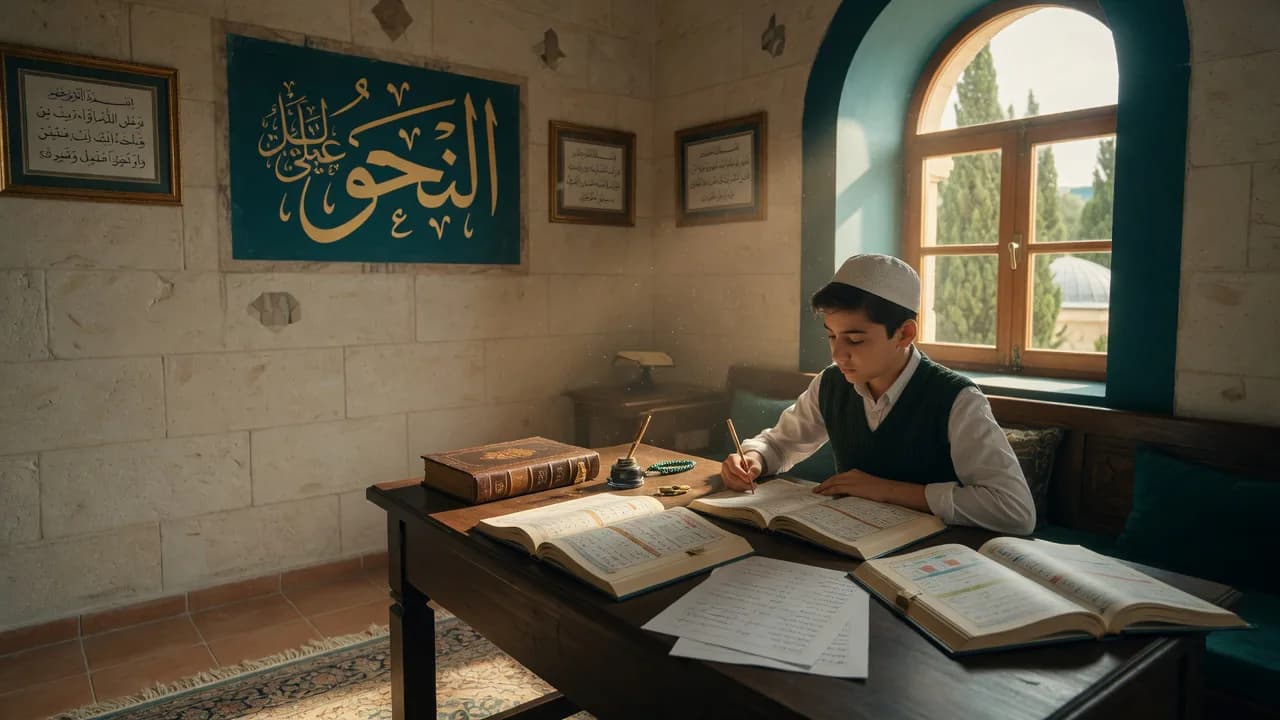
Arabic is the fundamental tool for directly accessing the primary sources of Islamic sciences. It is the language of the Qur'an, the language of Hadith studies and Islamic jurisprudence texts, and the common ground for works of Qur'anic exegesis and Islamic theology. Viewing this language merely as a translation-dependent tool creates a significant obstacle in the journey of knowledge. This is because the spirit of the text, the subtleties of the word, and the context of the sentence can only be grasped in their original language. DİDAR Academy's Arabic Preparatory Program, the first stage of its four-year curriculum, is designed precisely to meet this need.
One of the most common mistakes in learning Arabic is to separate grammar from text reading. Memorizing morphology and syntax rules is important; however, these rules are internalized only through regular text reading. Morphology education, starting with Mecmûatü's-Sarf, provides the student with verb patterns and the logic of derivation. In syntax lessons, classical texts such as Avâmil and Tuhfetü's-Seniyye teach the structure of the sentence. Text readings like Kasasun Nebiyyin and Riyâzü's-Sâlihîn allow the student to apply the learned rules to a living text.
At DİDAR, Arabic education is seen to extend across four fundamental skills: reading, comprehension, writing, and speaking. Reading skills are developed through tajwid and text lessons; comprehension skills through syntax and pre-Qur'anic exegesis language preparation; writing skills through spelling and text analysis; and speaking skills through conversation lessons. Conversational texts like el-Arabiyyetü beyne Yedeyke provide a foundation for students to actively use Arabic in daily life. The transformation of passive knowledge into active use is critically important for the sustainability of knowledge acquisition.
Continuity is indispensable for effective Arabic learning. In addition to weekly lessons, daily study and discussion sessions enable students to reinforce what they have learned. Study refers to working individually on a text, while discussion means debating the topic with a group of friends. When these two elements come together, the student becomes not just a consumer of information, but also a producer and sharer of knowledge. These two fundamental disciplines of the classical madrasa tradition are at the heart of DİDAR's educational model.
Patience and consistency are essential when learning Arabic. In the initial periods, the difficulty of the language can discourage students; however, this process can be overcome with a systematic program and guidance. Creating a daily study plan, setting weekly goals, and receiving feedback accelerates the process. At DİDAR Academy, progress tracking and qualified assessment practices clearly reveal in which areas the student is strong and in which areas they need support.
Vocabulary accumulation should not be neglected in Arabic learning. Noting new words encountered in every text reading, regularly repeating them, and using them in sentences rapidly improves language skills. At DİDAR, students acquire both moral advice and a rich vocabulary through texts like Riyâzü's-Sâlihîn. Over time, students become able to read classical texts without consulting a dictionary, which accelerates their pursuit of knowledge.
In the third term of the DİDAR curriculum, advanced syntax texts such as Ibn Hâcib's Kâfiye are introduced. At this stage, the student begins to grasp not only sentence construction but also the linguistic subtleties that open the doors to rhetoric. This gradual progression in Arabic learning is very important; each term builds upon the previous one. A skipped stage, rushed through, leads to serious difficulties in Qur'anic exegesis and Islamic jurisprudence texts in later years. Therefore, the completion of the Arabic preparatory period is clearly defined in the curriculum as a prerequisite for transitioning to Islamic sciences education.
In conclusion, Arabic is not an end in itself but an indispensable tool for the journey of knowledge. When the foundation of morphology and syntax, the practice of text reading, conversation lessons, and the discipline of study and discussion come together, the student becomes capable of reading classical sources and acquires the competence to contribute to contemporary scholarly discussions. DİDAR Academy's Arabic Preparatory Program offers this holistic approach within a systematic curriculum, preparing a solid foundation for young people in the pursuit of knowledge.