
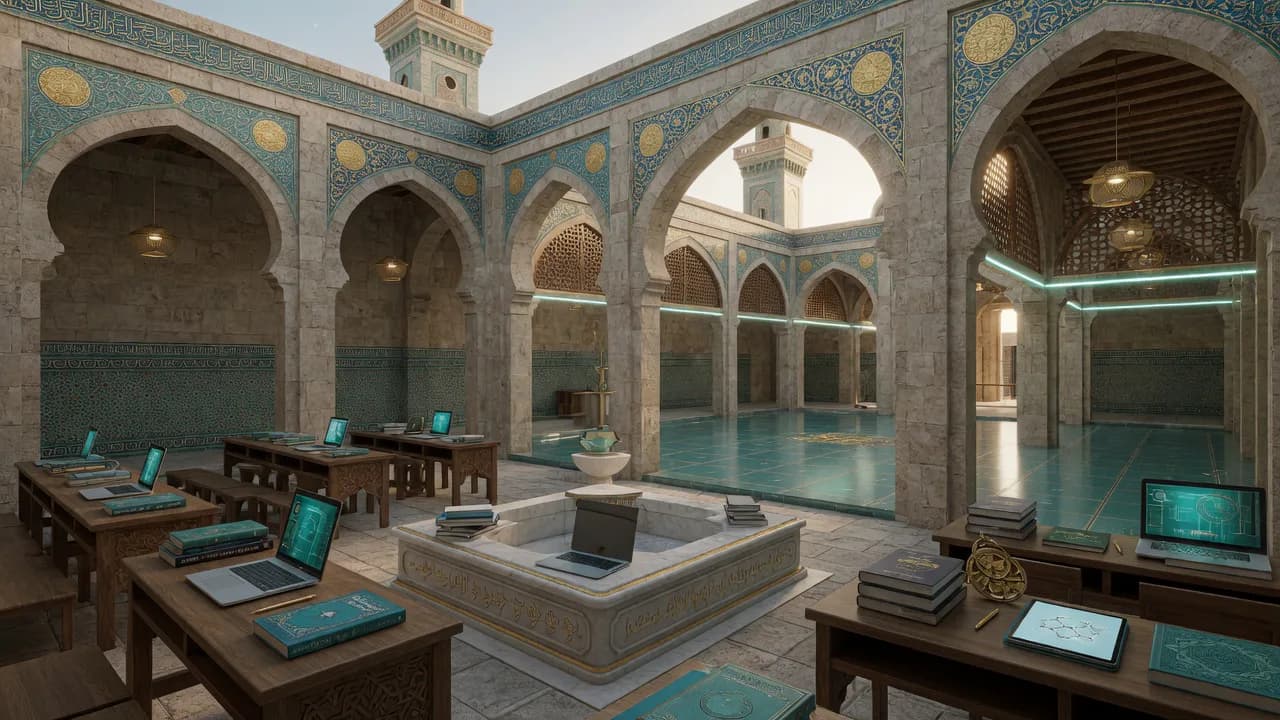
The Islamic madrasa tradition has been the primary center for the pursuit of knowledge for centuries, raising generations through disciplines such as individual study (mutalaa), group discussion (muzakara), text reading, and the teacher-student relationship. Today, the convergence of this tradition with modern educational conditions is crucial for both preserving the scholarly heritage and meeting the needs of contemporary students. DİDAR Academy steps in at this very point, offering a unique model that blends traditional madrasa discipline with modern educational planning. With over a decade of experience, it successfully implements this model in four different cities across Turkey.
At the heart of DİDAR's educational model lies the discipline of individual study (mutalaa) and group discussion (muzakara). In classical madrasas, daily individual study allows students to review the topics covered in class individually using the text. Group discussion, on the other hand, is the process where students come together to debate the topic and explain it to each other. DİDAR's curriculum includes a ten-credit Mutalaa-Muzakara course each term, demonstrating how central these two disciplines are at an institutional level. This method, referred to as "active learning" in modern educational terminology, is actually based on centuries of experience from the madrasa tradition.
Another fundamental element of the madrasa tradition is the teacher-student relationship. At DİDAR, the teacher is not merely an authority who lectures, but a scholarly guide who mentors the student on their journey of knowledge. Progress tracking, qualified assessment, and one-on-one feedback practices ensure that this relationship is maintained sustainably under modern educational conditions. The system of supervision, inspection, and reporting guarantees the transparency of the educational process. Parents can also regularly monitor the student's progress through this system.
Another dimension of the madrasa tradition that DİDAR integrates with modern education is its flexible program structure. While classical madrasas operate with a full-day education model, DİDAR accommodates the varying schedules of formal high school, open high school, formal university, and open university students. This flexibility ensures that Islamic sciences education is not exclusive to students who can dedicate full days. However, flexibility does not mean a lack of discipline; regardless of when a student attends class, they are obligated to complete the curriculum's required lessons and individual studies.
Weekly book analyses and scholarly seminars are modern extensions of the madrasa tradition at DİDAR. Classical madrasas also have a "tathir" tradition where certain works are comprehensively studied. At DİDAR, this tradition is kept alive through book analyses and seminars. Students are not limited to lecture notes; they broaden their scholarly knowledge by comprehensively examining works from different disciplines. Cultural and sports activities are also part of the education, supporting the student's social and spiritual development.
Another aspect of DİDAR's integration of the madrasa tradition with modern education is its four-year systematic curriculum. While in classical madrasas students would delve into various Islamic sciences for years, DİDAR has transformed this process into a planned four-year program. The first year is structured as Arabic language preparation, the second year as fundamental Islamic sciences, the third year as advanced Islamic sciences, and the fourth year as a specialization period. Each year builds upon the previous one; this gradual progression is one of the core principles of the madrasa tradition.
Theology Support, Supplementary Courses, and Academic Support programs are concrete examples of DİDAR's modern educational dimension. Especially students studying in faculties of theology find a qualified educational environment that supports their faculty courses. Providing supplementary support for school subjects such as Turkish, mathematics, physics, and chemistry demonstrates that DİDAR aims not only for scholarly success but also for general academic achievement. The Kayseri, Istanbul Anatolian, Istanbul European, and Kocaeli branches are reflections of this model in different geographies.
In conclusion, the convergence of the madrasa tradition with modern education forms the core identity of DİDAR Academy. When the discipline of individual study and group discussion, the teacher-student relationship, a systematic curriculum, and a flexible program structure come together, students gain access to both classical scholarly knowledge and meet contemporary educational needs. DİDAR continues to offer young people a profound scholarly heritage within a modern framework through this unique model.