
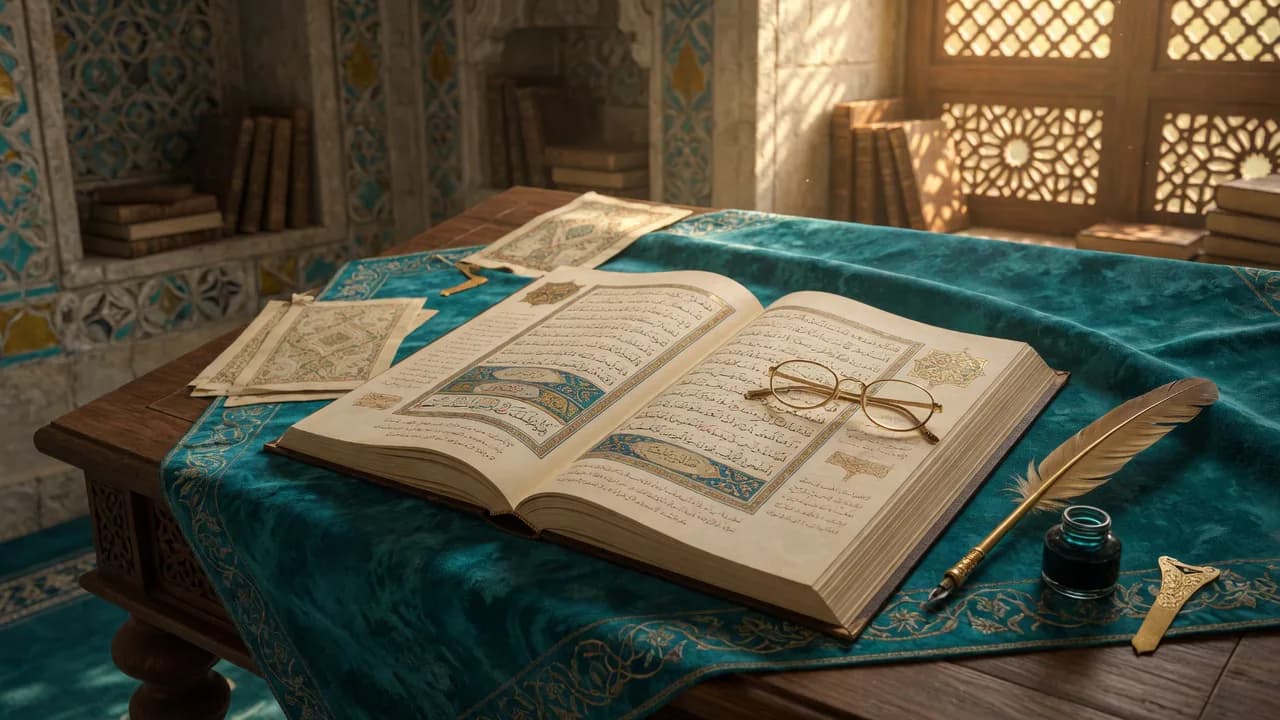
In the Islamic sciences tradition, a book is not merely a text to be read; it is a treasure of knowledge that lives with its teacher, its peers, and the tradition of commentaries accumulated over centuries. Book analysis is one of the most productive classical educational methods, where a work is examined as a whole, read chapter by chapter, discussed, and annotated. DİDAR Academy combines this tradition with modern educational planning by organizing weekly book analyses, aiming for students to acquire holistic reading skills rather than fragmented information.
The fundamental role of book analysis in education is to transform the student from a superficial information consumer into a deep reader. While specific topics are covered in daily lessons, book analysis addresses an entire work. The student grasps the author's method, terminology, argument structure, and scholarly stance. The Qur'anic exegesis methodology of Tabarī, the jurisprudential approach of Sarakhsī, or the spiritual refinement interpretation of Qushayrī can only be understood through the entirety of their works. The weekly analyses organized at DİDAR are directly linked to the texts in the curriculum.
The book analysis process consists of specific stages. First, the student individually studies the designated section; they look up unfamiliar words in a dictionary, analyze sentence structures, and take their own notes. Then, in a guided analysis session, the text is read and discussed with the instructor. Finally, mutual reflection on the topic takes place within a discussion group. This three-stage process transforms passive listening into active learning and deepens the student's relationship with the text.
At DİDAR Academy, book analyses are not merely a repetition of the course curriculum. They are an activity that goes beyond the topics covered in the curriculum, expands the student's reading list, and enables them to connect different disciplines. In a Qur'anic exegesis analysis, the student gains linguistic and narrative knowledge; in an Islamic jurisprudence analysis, they learn the evidence and reasoning for rulings; in a spiritual refinement analysis, they explore ethical and spiritual dimensions. This multi-dimensional experience allows the student to see the Islamic sciences not as disconnected fields but as a complementary whole.
The tradition of book analysis also develops the student's oral expression skills. In analysis sessions, students are expected to summarize the topic, ask questions, and participate in discussions. This practice provides young individuals who will serve as educators, preachers, or writers in the future with public speaking experience. Book analyses, as a natural extension of the discussion culture, also strengthen the social dimension of DİDAR's educational model.
Weekly book analyses are also directly linked to the discipline of individual study. The student reads the text individually before the analysis; this reinforces the habit of regular and careful work. Against the distraction brought by the digital age, book analysis provides the student with deep focus and continuous reading skills. A phone-free, silent, and disciplined study environment is the modern equivalent of scholarly etiquette.
For high school and university students, book analyses offer a qualified scholarly environment beyond school or faculty courses. Formal and distance education students can participate in analysis sessions according to their schedules. These activities, organized in DİDAR branches in Istanbul Anatolian, Istanbul European, Kayseri, and Kocaeli, enable students from different geographies to be part of the same scholarly tradition.
Note-taking and summarizing are also important skills in book analysis. Before the analysis, the student reads the text and records main arguments, important terms, and discussion points in their notes. After the analysis, they share these notes with the discussion group. This process ensures that the student is not just a listener but an active participant. At DİDAR, the culture of book analysis is conducted alongside note-taking discipline to support permanent learning.
In conclusion, the tradition of book analysis is one of the indispensable elements of DİDAR Academy's educational model. Weekly analyses offer a structure that is compatible with the curriculum, supported by the discipline of individual study and discussion, and provides students with holistic reading skills. Every young person who wishes to grasp the entirety of works rather than accumulating fragmented information in scholarly pursuits greatly benefits from the depth offered by the culture of book analysis. At DİDAR, books are not merely read; they are analyzed, discussed, and transformed into a scholarly legacy that lasts a lifetime.