
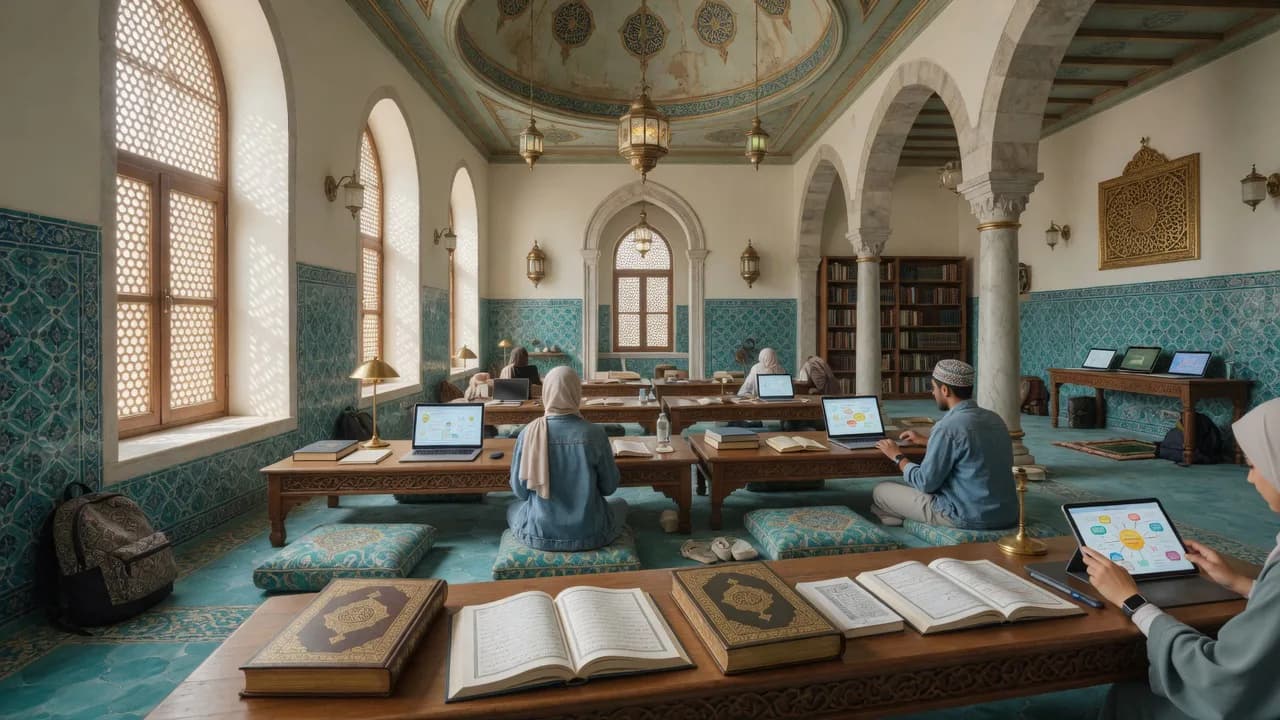
In Türkiye, students in formal high schools, open education high schools, formal universities, and open education faculties receive education at different times and paces. This diversity presents both an opportunity and a challenge for young people seeking Islamic studies. The opportunity lies in students from various life situations being able to embark on the path of knowledge; the challenge is how to reconcile Islamic studies with school or faculty schedules. DİDAR Academy steps in at this very point, offering a flexible yet disciplined academic system.
The fundamental characteristic of DİDAR's education model is its adaptability to the student's current educational status. A formal high school student can attend classes after school hours, a university student during gaps in their faculty schedule, and an open education student at times they determine themselves. This flexibility ensures that Islamic studies are not exclusively for those who can dedicate full-time. Branches in four different cities across Türkiye—İstanbul Anatolian, İstanbul European, Kayseri, and Kocaeli—enable access for students in various geographical locations.
Flexibility does not imply a lack of discipline. At DİDAR, the flexible schedule operates within a regular and systematic curriculum. Regardless of when a student attends class, they are obligated to complete the lessons, study sessions, and discussion sessions required by the curriculum. Progress tracking and qualitative assessment applications regularly measure whether the student is adhering to their program. This ensures a healthy balance between flexibility and discipline.
The model offered by DİDAR is particularly valuable for open education students. Open education provides students with ample room for time management; however, this freedom often leads to a lack of structural support. DİDAR provides both structure and community for open education students. Regular classes, study hours, and discussion groups help students overcome solitary study habits and become part of the scholarly community. The Academic Support program offered to open education theology students reinforces this support with supplementary courses and exam preparation studies that complement faculty courses.
Formal university students, especially those studying in theology faculties, benefit greatly from DİDAR's education model. Faculty curricula are broad and intensive; however, classical text reading practice can remain limited. DİDAR's four-year curriculum complements faculty education. Students learn the theoretical framework at the faculty, while at DİDAR, they engage directly with classical texts. When these two educational paths converge, the student gains a strong profile both academically and in terms of Islamic knowledge.
Extracurricular activities also hold a significant place in DİDAR's education model. Cultural and sports events, academic seminars, and book analyses ensure that students experience holistic development, not just focus on coursework. The development of social and spiritual aspects is clearly expressed among DİDAR's aims and objectives. Students experience character building alongside the acquisition of knowledge.
The model DİDAR offers for high school students is also particularly important. Classes held after school hours enable young people to utilize their free time productively. A high school student who is introduced to Arabic and fundamental Islamic studies at an early age begins university with a more equipped foundation.
Parental engagement is also an important part of DİDAR's flexible education model. The institution records every step of the educational process and provides regular feedback to parents. Student progress is evaluated not only by exam scores but also by multi-dimensional criteria such as study discipline, class participation, and accumulated Islamic knowledge. This transparency ensures that families can confidently engage in the educational process and enhances student motivation.
In conclusion, DİDAR Academy offers a flexible yet disciplined Islamic studies model for formal and open education students. Young people from diverse life situations can embark on the path of knowledge through this model; the systematic curriculum, study-discussion discipline, and progress tracking guarantee the quality of education. Every young person who wishes to pursue Islamic studies can begin this journey at a DİDAR branch suitable for their schedule.