
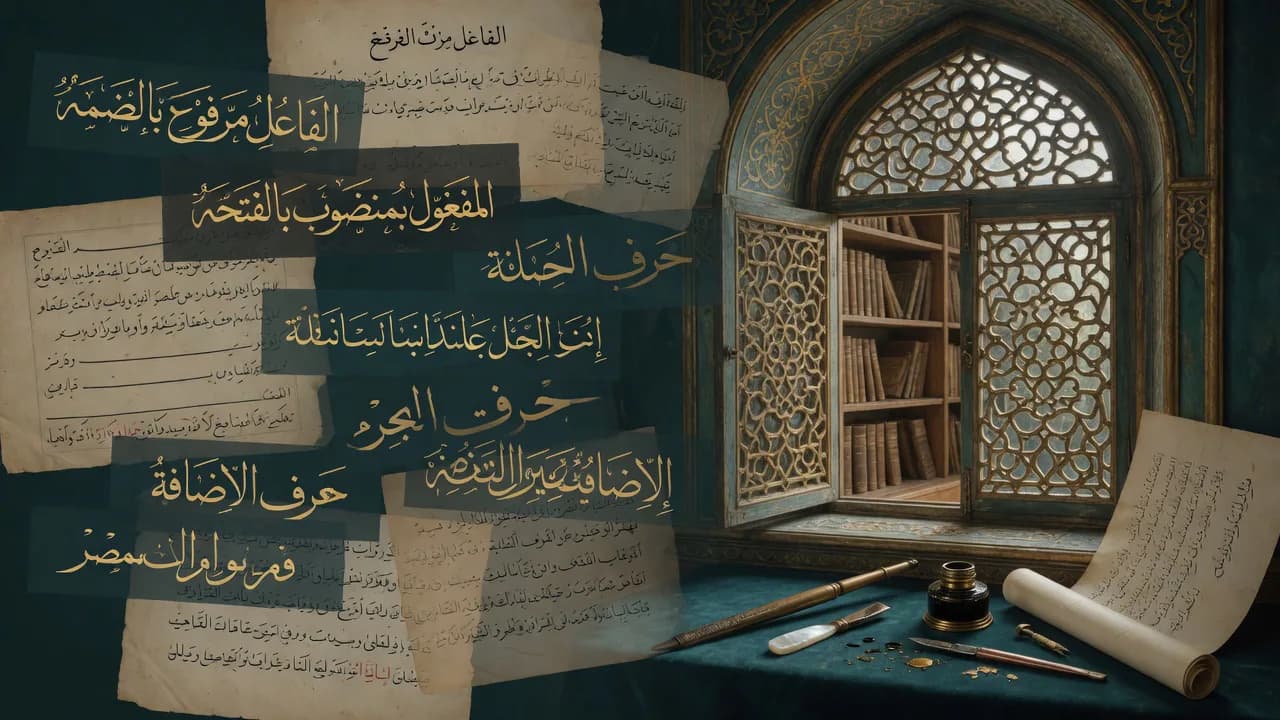
Nahw is a fundamental discipline that examines the structure of Arabic sentences, the relationships between words, and grammatical rules. The correct understanding of the Qur'an, Hadith, and Fiqh texts depends on a solid foundation in Nahw. In DİDAR Academy's Arabic Preparatory Program, Nahw education is conducted through a systematic curriculum that begins with Jurjani's Avamil and extends to Ibn Hājib's Kāfiya. This gradual progression allows students to first learn basic sentence structure and then advance to more complex Nahw issues.
In the first semester of the DİDAR curriculum, Nahw education is taught using two primary sources: Avamil and Tuhfetu's-Saniyya. Avamil, as one of the cornerstones of Nahw, teaches students the elements of a sentence and the concept of 'amil (governing agent). Tuhfetu's-Saniyya expands on this foundation by presenting Nahw rules systematically. Both texts are studied through memorization and text reading disciplines. Students do not merely memorize rules; they apply them to living examples in text readings such as Qasas al-Nabiyyin and Riyad al-Salihin.
Direct reading of classical texts in Nahw learning leads to a much deeper understanding than relying on translations or summarized works. The concise expressions of Avamil help students grasp the essence of Nahw logic. The commentary-based reading of Tuhfetu's-Saniyya, on the other hand, illustrates the rationale and application scope of each rule. At DİDAR, Nahw lessons are conducted through a triad of text reading with instructor guidance, individual mutalaa, and group müzakere. This structure enables students to transform their passive Nahw knowledge into an active skill.
The text of Kāfiya, introduced in the third semester, represents the advanced stage of Nahw education. This work by Ibn Hājib teaches students the intricacies of Nahw while also opening the doors to rhetoric (balaghah). The reading of Kāfiya builds upon the Maksud and Izzi chapters completed in Sarf education. At this stage, students no longer merely analyze simple sentences; they begin to grasp complex structures, metaphorical usages, and Nahw disputes. This depth is a prerequisite for transitioning to the Tafsir and Fiqh texts to be studied in the second year.
The discipline of individual study (mutalaa) and group discussion (muzakara) in Nahw (Arabic grammar) is central to the DİDAR educational model. The 10-credit Mutalaa-Muzakara course offered each term provides a dedicated space for reinforcing Nahw topics. Students individually review the Nahw topic covered in class during their mutalaa sessions, and then deepen their understanding from different perspectives by discussing it with peers in muzakara groups. This process ensures that Nahw knowledge becomes permanent and enables students to independently analyze texts.
Students studying at faculties of theology quickly realize how critical Nahw knowledge is in their faculty's Arabic courses. DİDAR's Nahw education offers these students a solid foundation that supports the faculty curriculum. Supplementary courses provided within the Academic Support program are particularly beneficial for theology students who wish to improve their Arabic text-reading skills. Both full-time and distance education students can regularly attend Nahw classes thanks to the flexible program structure. Nahw classes conducted at the Kayseri, Istanbul, and Kocaeli branches are also supported by parent feedback and progress reports.
To succeed in Nahw, it is necessary to progress alongside Sarf (morphology) knowledge, regularly engage with texts, and be patient. Skipping a Nahw stage in haste can lead to serious difficulties in Tafsir and Fiqh texts in later years. DİDAR's curriculum foresees this risk and has planned Nahw education in a gradual and systematic manner. Progress tracking applications transparently show the student's level of advancement in each text.
In conclusion, Nahw is an indispensable part of Arabic preparation. When the classical chain of texts, ranging from Awamil to Kafiya, is combined with the discipline of mutalaa-muzakara and text-reading practice, students reach a level where they can read classical scholarly sources. DİDAR Academy's Nahw education strengthens the linguistic foundation of the four-year curriculum, equipping young people with deep and lasting Nahw knowledge.