
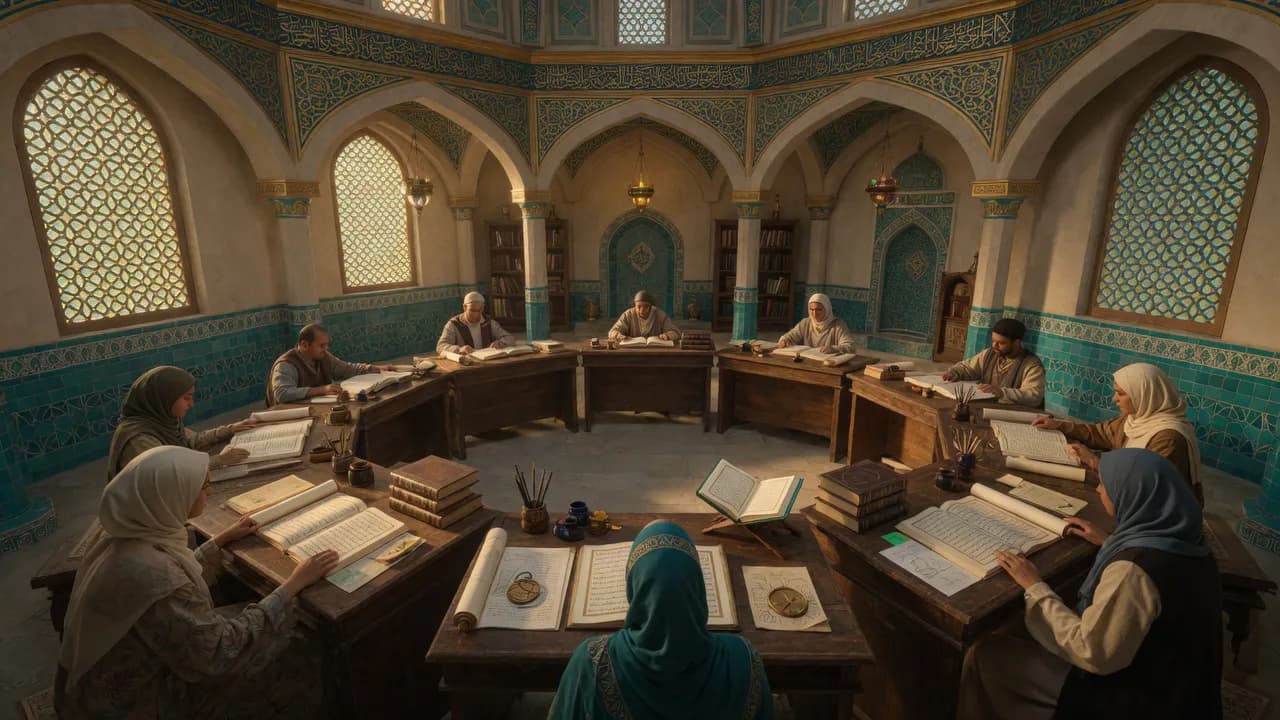
In the Islamic scholarly tradition, learning is not merely an individual activity. From the time of the Companions and the Tabi'in, scholars gathered to discuss topics, read texts together, and learn from one another. DİDAR Academy's educational model integrates this communal tradition with modern educational planning, placing group work and the formation of a knowledge community at the core of its curriculum. Deliberation sessions, book analyses, and scholarly seminars are concrete reflections of this culture.
The fundamental discipline of group work at DİDAR is deliberation (muzakara). Deliberation means students coming together to discuss a lesson topic, explain it to each other, and reflect on common questions. Information conveyed by the instructor during class becomes permanent when shared among students in a deliberation setting. A grammatical rule explained by one student allows another student to grasp it from a different perspective. In this process, the instructor guides, corrects misunderstandings, and deepens the discussion. This structure encourages peer-to-peer learning beyond classroom instruction.
Individual study (mutala'a) and deliberation (muzakara) are two complementary elements. Mutala'a refers to individual work, while muzakara refers to group discussion. In the DİDAR curriculum, each term includes a ten-credit Mutala'a-Muzakara course, demonstrating the emphasis on these two disciplines in education. Students first individually examine the text, take notes, and mark points they don't understand; then they meet with their deliberation group to discuss these questions. This cycle is repeated for every lesson topic and builds the student's scholarly knowledge in a layered manner.
Book analyses are among the most productive applications for forming a community of knowledge. In these sessions, where a specific work is examined in its entirety, students grasp not just fragmented information but the holistic logic of a work. Weekly book analyses organized at DİDAR broaden students' reading lists and enable them to make connections between different disciplines. Discussing Tafsir, Hadith, Fiqh, or Kalam texts in a communal setting enhances students' oral expression skills and strengthens their awareness of being part of a scholarly community.
Scholarly seminars are also an important extension of the group work culture. Seminars, where specific topics are presented by expert educators, enable students to acquire knowledge on subjects outside the curriculum. The question-and-answer sessions after seminars are a natural continuation of the deliberation culture. Students are involved in the process as both listeners and participants, which accelerates the transition from passive to active learning.
The skills students gain from group work are not solely academic. Competencies such as critical thinking, oral expression, active listening, and collaboration naturally develop during deliberation processes. Students who will later serve as educators, preachers, writers, or researchers greatly benefit from the group discussion experience. Overcoming the fear of public speaking and explaining complex topics in simple language are all fruits of the knowledge community culture.
At DİDAR, the community of knowledge is not limited to class hours. Extracurricular cultural and sports activities contribute to strengthening social bonds. The fraternal relationships among students are shaped around the common goal of knowledge. This sense of community is the practical equivalent of ummah consciousness in education. DİDAR's aims and objectives, including the phrase "to raise well-equipped individuals who can assume responsibility in society," demonstrate how this community culture directly aligns with its goals. Development tracking and qualified assessment practices also transparently manage the process by measuring students' contributions within the community.
In conclusion, group work and forming a community of knowledge are inseparable parts of the DİDAR Academy educational model. When deliberation, individual study, book analyses, and scholarly seminars come together, students transform from mere accumulators of information into scholars who share and produce knowledge. The journey of knowledge is not walked alone; at DİDAR, every student continues this journey as part of a strong community of knowledge. The continuation of this same culture across four branches ensures that this communal consciousness extends beyond regional boundaries.