
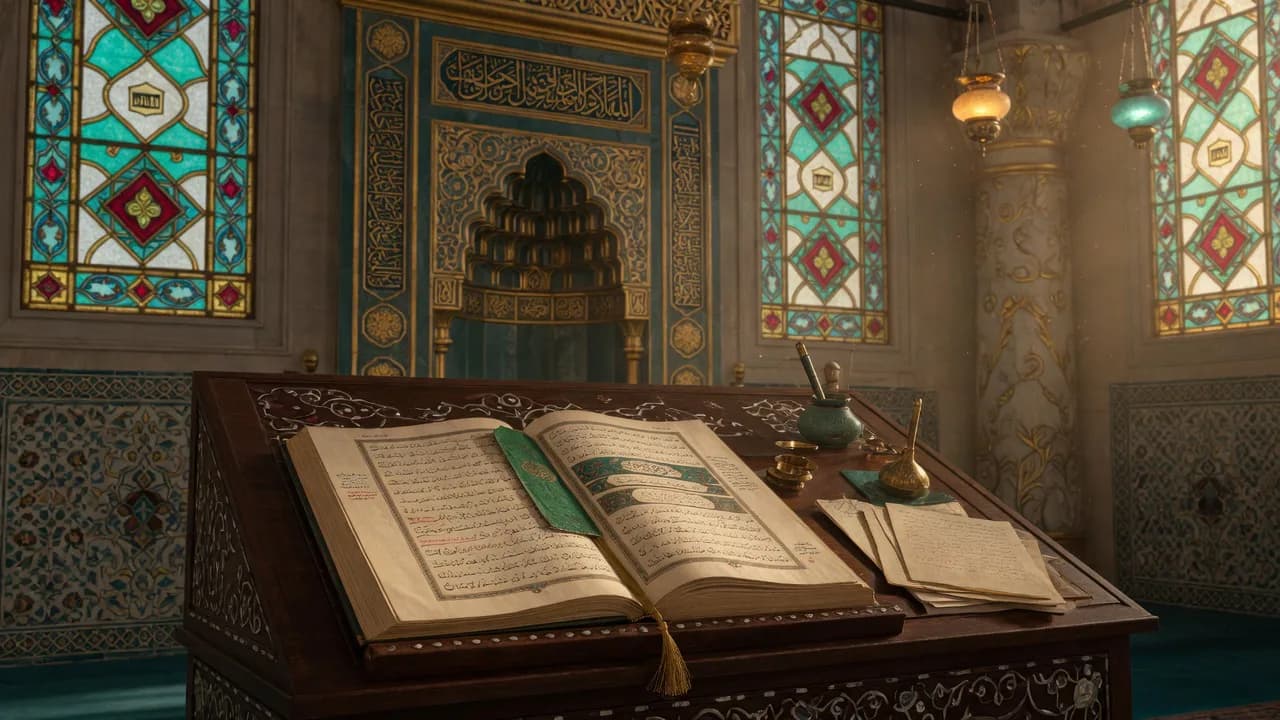
Tafsir (exegesis of the Qur'an) is one of the most fundamental branches of Islamic studies, aiming to understand the verses of the Holy Qur'an through their linguistic, contextual, narrative, and interpretive dimensions. Correctly reading and understanding the Qur'an, which serves as a guide for Muslims, yields profound results at both individual and societal levels. Therefore, Tafsir education is not merely an academic specialization but a fundamental need encountered by every Muslim on their journey of knowledge. In DİDAR Academy’s second-year curriculum, Tafsir texts hold a central place; students engage directly with classical sources, starting from al-Tabari’s Jami al-Bayan to al-Razi’s Mafatih al-Ghayb and al-Qushayri’s Lata'if al-Isharat.
When commencing Tafsir study, it is essential first to acquire knowledge of usul (principles/methodology). Usul al-Tafsir determines how a verse should be read, which narrations to consult, and where the boundaries of interpretive Tafsir (Tafsir bi al-diraya) are drawn. Reading texts without knowledge of usul can lead to interpretations detached from context or incorrect positioning of narrations. At DİDAR, Tafsir education begins after the completion of the Arabic preparatory period, as Tafsir texts require proficiency in the Arabic language. The student first strengthens their language skills, then proceeds to reading texts.
Classical Tafsir sources represent different approaches. Imam al-Tabari’s Jami al-Bayan is one of the most comprehensive examples of narrative Tafsir (Tafsir bi al-riwaya). The reasons for revelation (asbab al-nuzul) of verses, as well as the views of the Companions and the Successors (tabi'in), are presented with rich detail in this work. Al-Razi’s Mafatih al-Ghayb, on the other hand, is a comprehensive commentary that delves into the depths of interpretive Tafsir (Tafsir bi al-diraya), encompassing theological (kalam) and philosophical issues. Al-Qushayri’s Lata'if al-Isharat is an important representative of the Sufi Tafsir tradition. The sequential reading of these sources provides the student with the opportunity to recognize different methods and schools of thought in Tafsir.
The discipline of text reading in Tafsir classes consists of the following stages: first, the text is studied silently; then, it is read and discussed under the guidance of the instructor; finally, the student takes their own notes and shares them with the discussion group. This process enables the student to transition from being a passive listener to an active scholar. Paying attention to the wording (lafz), metaphor (majaz), analogy (qiyas), and inference (istidlal) of the verse are fundamental steps in Tafsir study.
Today, various translated and summarized works related to Tafsir are available. These can be useful at an introductory level; however, true depth is gained through direct reading of classical texts. Translation offers an understanding filtered through the interpreter; the original text, however, confronts the student directly with the source. DİDAR Academy’s prioritization of classical texts in Tafsir education is a practical reflection of this principle.
The relationship between Kalam (Islamic theology) and Tafsir is also taken into account in the DİDAR curriculum. Kalam texts such as al-Maturidi’s Kitab al-Tawhid and al-Nasafi’s al-Aqa'id help students correctly position creedal matters while reading Tafsir. Tafsir is not merely a matter of language and narration; it also encompasses dimensions of faith, ethics, and law. This holistic approach enables the student to integrate the Qur'an into every aspect of their life.
In Tafsir study, the reasons for revelation (asbab al-nuzul) and the distinction between Meccan and Medinan verses also hold significant importance. Knowing the context in which a verse was revealed is a prerequisite for correctly understanding its ruling and scope. In al-Tabari’s narrative Tafsir, this information is richly presented; the student learns both the wording of the verse and its historical context simultaneously. Weekly book analyses and academic seminars are also regularly conducted at DİDAR as extracurricular extensions of Tafsir education.
Success in Tafsir requires patience, consistency, and correct source selection. The student should progress without haste, by learning the methodology (usul) and maintaining regular contact with the texts. Considering the context, wording (lafz), and ruling of each verse together transforms superficial reading into deep understanding. In DİDAR’s four-year curriculum, Tafsir courses deepen each year with a different source; this allows the student to become acquainted with the narrative (riwaya), interpretive (diraya), and Sufi Tafsir traditions. Every young person aspiring to understand the Qur'an on their journey of knowledge can achieve this goal through a solid Tafsir education.