
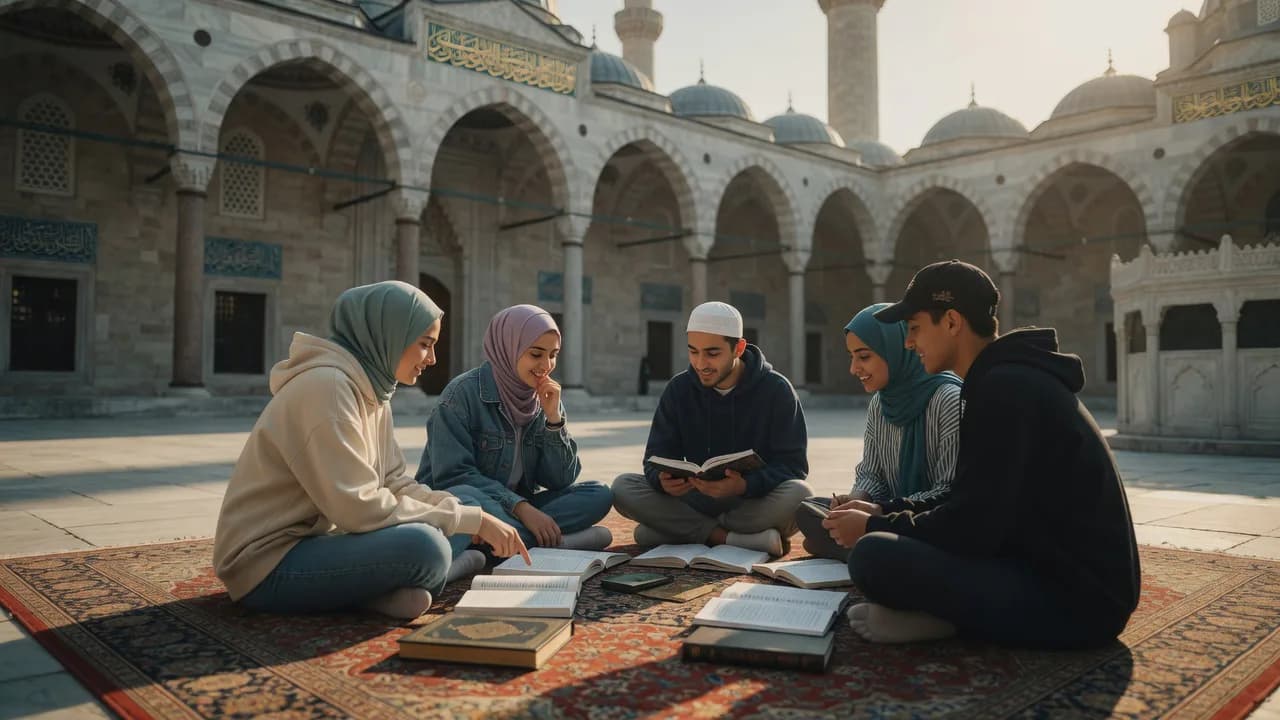
In the Islamic scholarly tradition, learning is not merely about listening to the teacher. The real transformation occurs during mütalaa, when the student engages individually with the text after class, and in the müzakere environment, where they discuss the topic with peers. These two concepts have formed the backbone of the madrasa tradition for centuries; today, institutions like DİDAR Academy keep this discipline alive by integrating it with modern educational planning. The DİDAR curriculum includes a ten-credit Mütalaa-Müzakere course each term, demonstrating the centrality of these two disciplines.
Mütalaa is the process where the student individually reviews the topic covered in class on the text, goes over their notes, and completes any missing points. Its dictionary meaning is "examination, research." During mütalaa, the student does not rush; they read the text line by line, look up unfamiliar words in a dictionary, analyze sentence structures, and take their own notes. This process transforms the student from a passive recipient into an active researcher. A grammar topic covered during class becomes permanent when reinforced through mütalaa.
Müzakere, on the other hand, is when students come together to discuss the class topic, explain it to each other, and reflect on common questions. The word "müzakere" in Arabic means mutual conversation, debate, and collective thinking. In a müzakere setting, a student reinforces their own knowledge by explaining the topic; the listening student grasps the topic from a different perspective. The teacher guides this process, corrects misunderstandings, and deepens the discussion. This structure encourages peer-to-peer learning beyond classroom instruction.
At DİDAR Academy, mütalaa and müzakere are conducted regularly every day. After morning classes are completed, students work individually during mütalaa hours; in the evening or at designated times, müzakere groups gather. This arrangement ensures that the student is immersed in Islamic sciences throughout the day. Weekly book analyses and scholarly seminars are also natural extensions of this culture. The student does not merely prepare for exams; they integrate scholarly knowledge into their daily life.
The skills gained by the student through the discipline of mütalaa and müzakere are not only academic. Competencies such as critical thinking, verbal expression, active listening, and collaboration naturally develop during these processes. Students who will later serve as educators, preachers, writers, or researchers greatly benefit from the müzakere experience. Overcoming the fear of public speaking, explaining complex topics in simple language; all these are the fruits of the müzakere culture.
In today's digital age, the distraction caused by digital devices makes the discipline of mütalaa even more important. Social media and short video content make deep focus difficult. Mütalaa hours provide the student with a phone-free, attentive, and continuous study habit. This habit makes a difference not only in the pursuit of Islamic sciences but in every area of life. DİDAR Academy's disciplined educational environment provides the groundwork for students to acquire this valuable habit.
Book analyses are one of the most productive applications of the mütalaa and müzakere tradition. In these sessions, where a specific work is examined as a whole, the student grasps not only fragmented information but also the holistic logic of a work. The weekly book analyses organized at DİDAR broaden the student's reading list and enable them to connect different disciplines.
The culture of mütalaa and müzakere also deepens the student's relationship with their teacher. The teacher becomes not just an authority who delivers lessons, but a scholarly guide who mentors during the müzakere process. This relationship is the modern educational equivalent of traditional madrasa etiquette. The student approaches their teacher with respect, and the teacher individually monitors the student's development. DİDAR's supervision, inspection, and reporting system ensures that this relationship operates transparently and sustainably.
In conclusion, mütalaa and müzakere are the heart of learning Islamic sciences. Classes represent the moment knowledge is transmitted; mütalaa and müzakere are the process by which this knowledge settles in the student's mind and heart. DİDAR Academy aims to provide its students with a lasting accumulation of Islamic sciences by placing these two disciplines at the center of its curriculum.