
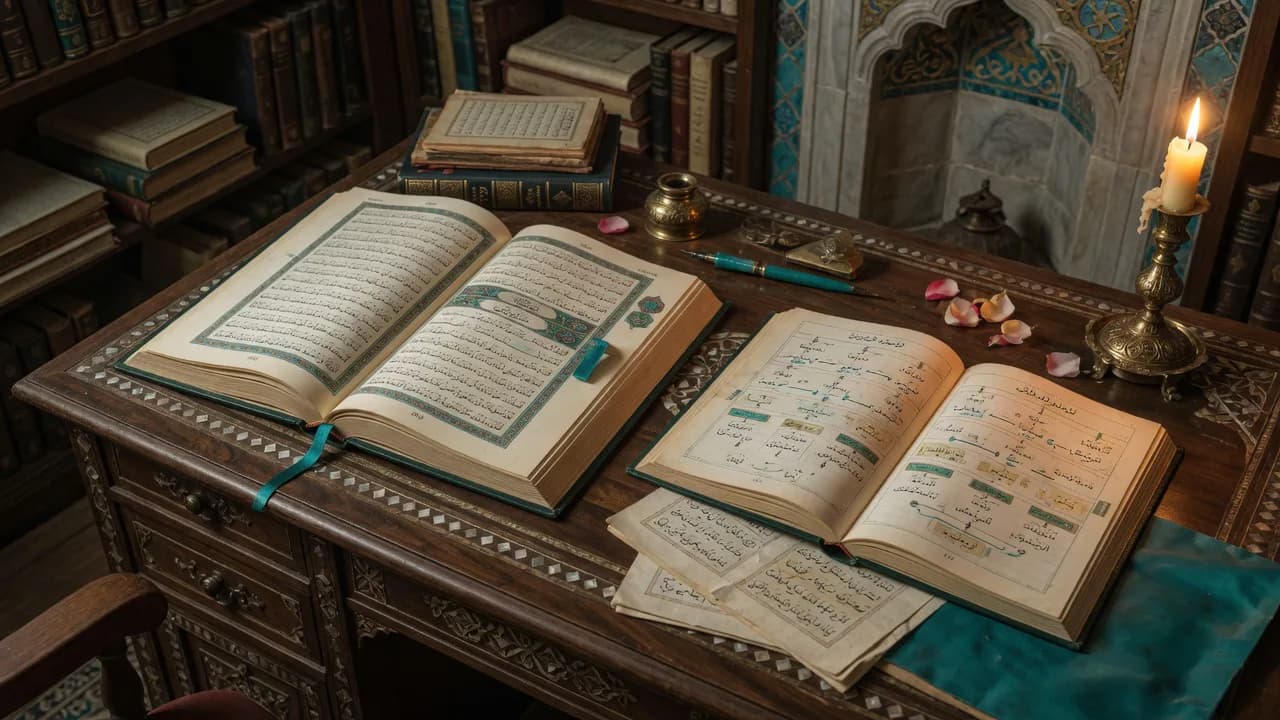
Qur'an memorization (Hifz) is one of the most valuable legacies of Islamic education. Memorizing the Holy Qur'an at a young age provides students with both a spiritual treasure and a strong linguistic and memory foundation. However, after completing memorization, many students and families face the question, "What's next?" The meaning of the memorized surahs, their Tafsir (exegesis) dimension, and the transition to other Islamic studies are often unplanned. DİDAR Academy offers a roadmap that systematically plans post-memorization academic study for Qur'an memorizer students.
The primary need for a Qur'an memorizer student is to understand the Qur'an they have memorized. During the memorization process, most students focus on recitation and memorization; the meaning and Tafsir aspects may remain limited. In the DİDAR curriculum, the Holy Qur'an and its Translation course enables students to grasp the meaning of the surahs they have memorized. The verses of Surah al-Baqarah are read sequentially, and translation work is done. When a Qur'an memorizer student learns what the verses they have memorized mean, their memorization transforms into a profound body of knowledge.
The second step is Arabic language education. The Qur'an memorizer student has memorized the Qur'an in Arabic; this is a great advantage. However, memorization is not the same as grammar and textual reading skills. DİDAR's Arabic Preparatory Program systematizes the Qur'an memorizer student's existing Arabic knowledge through courses in morphology (sarf), syntax (nahw), and textual reading. Students can now read not only Qur'anic verses but also Hadith, Tafsir, and Fiqh texts.
The third step is to embark on foundational Islamic studies. In DİDAR's four-year curriculum, Tafsir, Hadith, Fiqh, Kalam, and Sufism courses begin in the second year. The Qur'an memorizer student is introduced to classical sources such as Tabari's Jami' al-Bayan, Bukhari's Sahih, and Sarakhsi's al-Mabsut. Seeing the Tafsir of the verses they have memorized in these texts offers the Qur'an memorizer student a unique experience of coherence.
The discipline of study and discussion is particularly important for Qur'an memorizer students. During the memorization process, individual study habits are strong; DİDAR supports this habit with a culture of study and enhances social learning through discussion. Weekly book analyses and academic seminars ensure that the Qur'an memorizer student becomes part of the scholarly community. The student transforms from merely memorizing to becoming a scholar who thinks and discusses.
The role of families in the academic journey of Qur'an memorizer students is critical. After the memorization period, students may experience a loss of motivation; the feeling of "what will I study now?" is common. During this period, the family must guide the student, support their Islamic education, and follow up patiently. DİDAR provides regular feedback to parents, transparently sharing the student's progress. Progress is measured not only by exam scores but also by the discipline of study and scholarly accumulation.
Qur'an memorizer students in high school and university greatly benefit from DİDAR's flexible program. Class schedules that do not conflict with school or faculty programs enable students to pursue both academic and Islamic development simultaneously. Branches in Istanbul Anatolian, Istanbul European, Kayseri, and Kocaeli reach Qur'an memorizer students in different cities.
The connection between recitation and Tafsir is also an important part of the roadmap for Qur'an memorizer students. Learning the context of revelation, the rulings contained within, and how they are interpreted in the Tafsir tradition deepens the memorization. In the DİDAR curriculum, the Quran and Translation course, along with Tafsir texts, provide this integration. When the Qur'an memorizer student knows the meaning and Tafsir of the verse they recite, their relationship with the Qur'an becomes much more meaningful.
In conclusion, memorizing the Qur'an is not the end of a scholarly journey but a strong beginning. Deepening the memorized knowledge through understanding, Arabic, and text reading is the most important step for the Qur'an memorizer student. DİDAR Academy guides Qur'an memorizer students on this journey with a four-year curriculum, study-discussion discipline, and academic support. Memorizing the Qur'an is not an end in itself, but a valuable gateway to becoming a person of knowledge; every young person who passes through this door can achieve deep scholarly knowledge with the right guidance.