
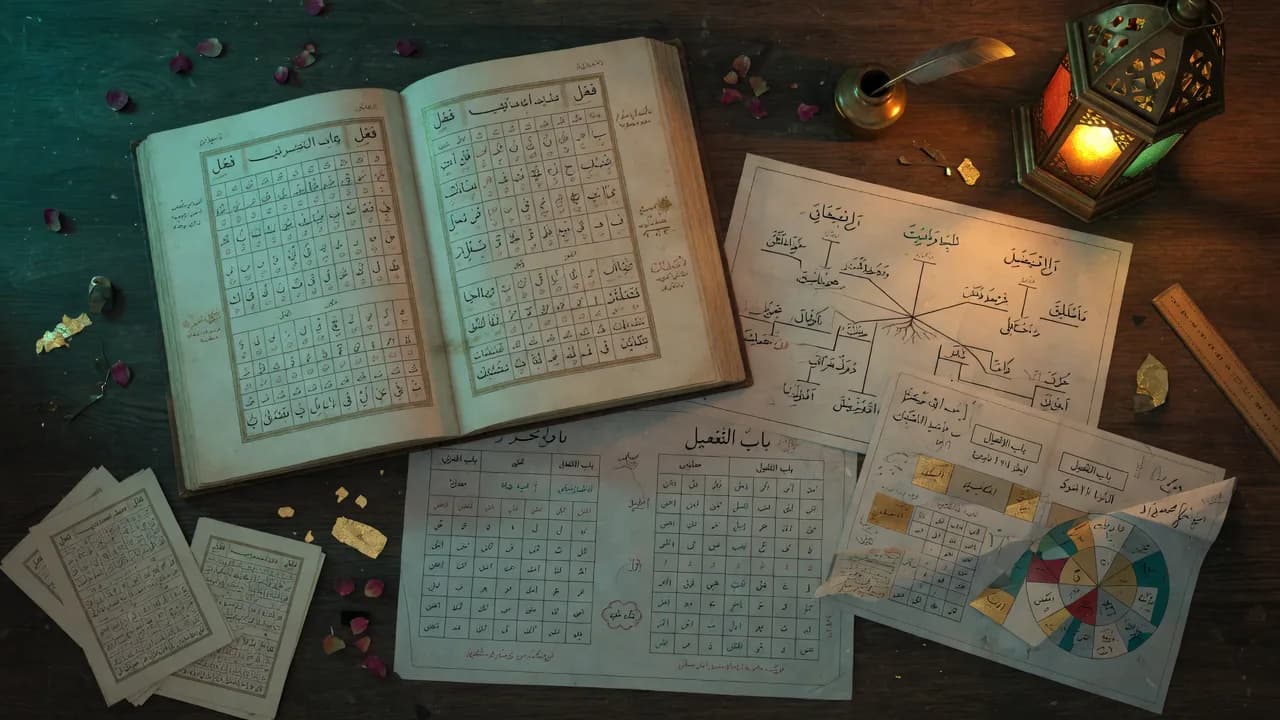
Sarf (morphology) is a fundamental discipline that examines the structure of Arabic words, verb patterns, and derivation rules. Since almost all Islamic sciences are based on Arabic texts, knowledge of sarf is a prerequisite for students to read texts in Qur'anic exegesis, Hadith studies, and Islamic jurisprudence. In the first-year curriculum of DİDAR Academy, sarf education is systematically taught using Mecmûatü's-Sarf texts. The program, which begins with the Emsile, Bina, and Maksud chapters, deepens with the İzzi and Zurûf chapters, providing students with the logical framework of verb patterns.
One of the most common mistakes in learning sarf is separating rules from text reading. Memorizing verb patterns is important; however, this memorization only becomes meaningful with regular text reading and discussion. At DİDAR, sarf lessons are not merely about conveying rules; they are a process that progresses line by line through texts, questioning the logic of each pattern. While learning the structure of triliteral verbs in the Emsile chapter, students also encounter these patterns with live examples in text readings such as Kasasun Nebiyyin. This holistic approach prevents sarf knowledge from turning into a dry list of formulas.
Memorization discipline is an integral part of sarf education; however, at DİDAR, memorization is not applied as blind repetition but as a conscious method supported by understanding and application. In the sections of Mecmûatü's-Sarf that require memorization, students first grasp the logic of the pattern, then repeat the examples, and explain them to their peers in discussion groups. This process ensures that the memorized information is stored in long-term memory. Additionally, during daily study hours, students individually review the sarf topics covered in lessons, completing any gaps in their understanding.
The text reading discipline in sarf consists of the following stages: first, the text is silently studied, then read and discussed under the guidance of the instructor, and finally, the student takes their own notes and shares them with the discussion group. This structure is a combination of the classical madrasa tradition with modern educational planning. The student not only memorizes verb patterns but also acquires a linguistic skill that allows them to instantly identify the pattern of a verb encountered in a text. This skill greatly facilitates the reading of Islamic jurisprudence texts such as those by Serahsî, Kâsânî, and İbn Âbidîn in later years.
In the third term of the DİDAR curriculum, sarf education is completed with the Maksud and İzzi chapters. At this stage, the student has internalized the basic verb patterns and can now analyze more complex sentence structures in nahiv (syntax) lessons alongside the Kâfiye text. The parallel progression of sarf and nahiv is one of the fundamental principles of DİDAR's Arabic Preparatory Program. A gap in one discipline creates difficulty in the other; therefore, the curriculum advances both areas simultaneously and in a balanced manner.
Formal high school and university students, as well as open education students, can participate in sarf lessons thanks to DİDAR's flexible program structure. Classes held at times that do not conflict with school or faculty schedules allow students to continue their pursuit of knowledge. Sarf education, conducted in DİDAR branches in Kayseri, Istanbul, and Kocaeli, is supported by progress tracking and qualified assessment practices. It is regularly measured in which patterns the student is strong and in which they need support, and individual feedback is provided.
Patience, consistency, and regular repetition are essential for success in sarf. Students should progress without rushing, learning each pattern thoroughly. Daily study habits, weekly discussion group participation, and text reading practice; when these three elements come together, sarf knowledge becomes permanent. Students studying in faculties of theology can also benefit from DİDAR's sarf education to achieve stronger performance in their faculty's Arabic lessons. Supplementary courses offered within the Academic Support program facilitate this transition.
In conclusion, sarf is the cornerstone of Arabic preparation. When text reading, memorization discipline, and the culture of study and discussion come together, students both grasp verb patterns and become ready for classical scholarly texts. DİDAR Academy's sarf education, centered on Mecmûatü's-Sarf, forms the solid foundation of the four-year curriculum, enabling young people to confidently take the first and most critical step in their journey of knowledge.