
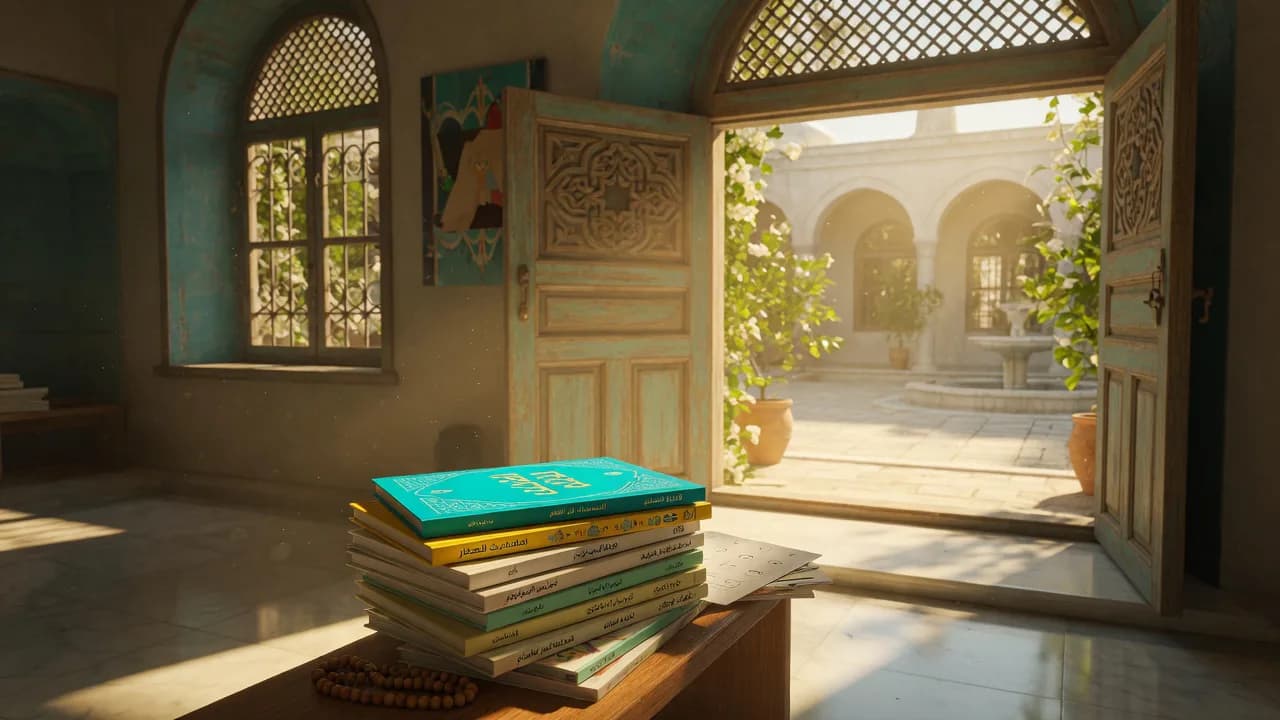
Many young people aspiring to embark on the journey of knowledge don't know where to start. Arabic, Tafsir, Hadith, or Fiqh? Which sources are reliable, which methods are effective? These questions are common concerns for young people who are eager for knowledge but also seek a guiding framework. With over a decade of experience, DİDAR Academy is an educational institution that offers systematic answers to these questions. In this article, we provide a practical guide for young people who wish to take the first step on the journey of knowledge.
The first step in the journey of knowledge is intention. The acquisition of knowledge should begin not as a worldly career goal or a means to social status, but with the intention of gaining Allah's pleasure and benefiting the Ummah. This intention enables patience and steadfastness in the face of difficulties. Among DİDAR Academy's aims and objectives is the statement “to raise equipped individuals who prioritize Ummah consciousness and can assume responsibility in society”; this demonstrates that the aspect of intention in education is also valued at the institutional level.
The second step is Arabic language education. The primary sources of Islamic studies are in Arabic; in-depth study of Islamic sciences is impossible without learning this language. The first year of DİDAR's four-year curriculum is entirely dedicated to Arabic preparation. Through lessons in morphology (sarf), syntax (nahw), text reading, and conversation (muhadatha), students reach a level where they can read Tafsir, Hadith, and Fiqh texts in their second year. Learning Arabic systematically and without haste is the most solid foundation for the journey of knowledge.
The third step is to begin studying the foundational Islamic sciences. After completing Arabic preparation, students are introduced to classical texts in Tafsir, Hadith, Fiqh, Kalam, and Sufism. In DİDAR's curriculum, these sciences run in parallel; students focus not just on one field per year, but on all fundamental areas simultaneously. This holistic approach ensures that students view Islamic studies not as disconnected subjects, but as a complementary whole.
The fourth step is to acquire the discipline of mütalaa (study and contemplation) and müzakere (discussion). Classes represent the moment knowledge is transmitted; true learning occurs through mütalaa and müzakere processes. Consistent daily mütalaa, participation in weekly discussion groups, and developing note-taking habits ensure the sustainability of the journey of knowledge. At DİDAR, these disciplines are central to the curriculum, and a serious commitment is expected from students.
The fifth step is choosing the right community and guidance. The journey of knowledge cannot be undertaken alone; the guidance of a community of scholars and reliable educators is essential. DİDAR Academy's four branches, academic staff, and over a decade of experience provide this guidance within an institutional framework. Students not only attend lectures but also become part of a scholarly community, grow alongside their peers, and receive one-on-one feedback from their educators.
There is no specific age or educational level required to embark on the journey of knowledge; however, high school and university students are at the core of DİDAR's target audience. Regardless of whether they are enrolled in formal or distance education, any young person dedicated to acquiring knowledge can apply. Applications are reviewed by the relevant center and educational staff, and suitable candidates are contacted.
During the application process, information is gathered about the student's Qur'an recitation level; students with Tajwid knowledge adapt more quickly to the Arabic preparatory program. Applications can be made by selecting one of the Kayseri, Istanbul, or Kocaeli branches. Detailed information can be obtained through DİDAR's website and communication channels; students and parents can visit a center to see the educational environment firsthand. The journey of knowledge is a long marathon; taking the right step today lays the foundation for becoming a person of knowledge tomorrow.
In conclusion, the journey of knowledge begins with the right intention, a foundation in Arabic, a systematic curriculum, the discipline of study and discussion, and reliable guidance. DİDAR Academy brings these elements together, offering young people the opportunity to partake in a profound legacy of knowledge. Every young person wishing to embark on the journey of knowledge can use this guide as a roadmap and begin their education at one of DİDAR's branches.