
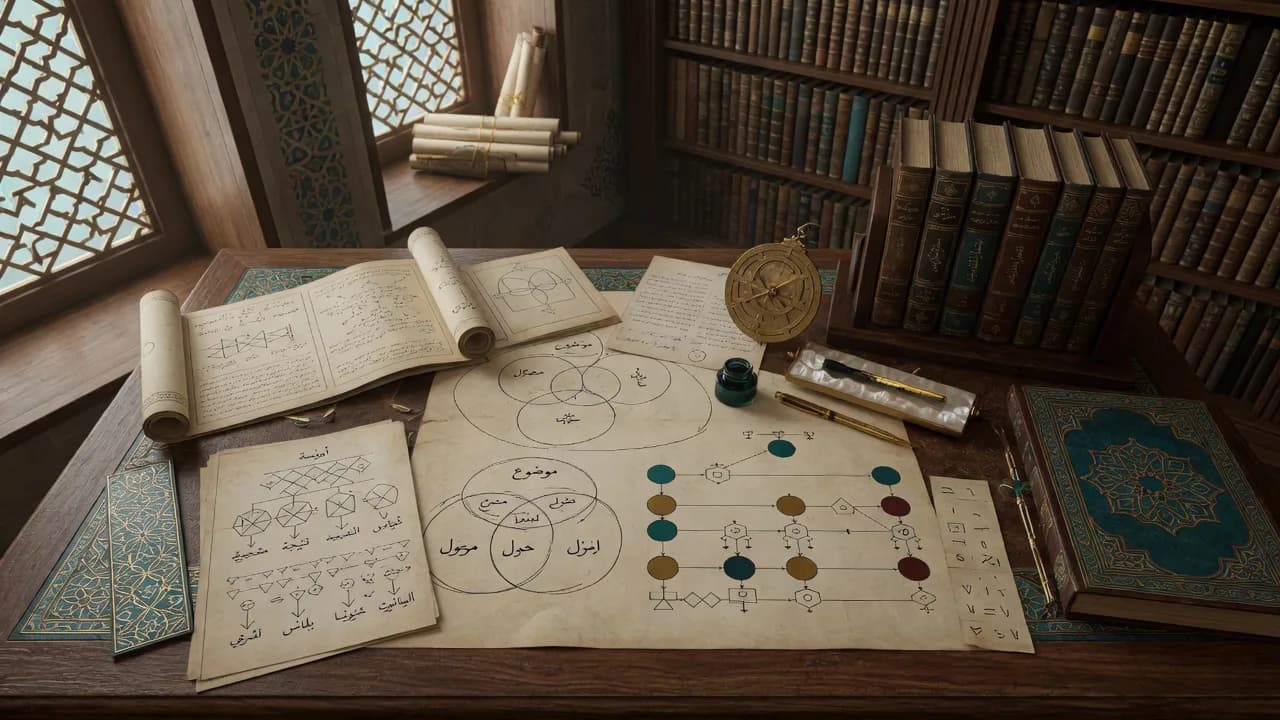
The science of logic is a fundamental discipline that examines methods of correct thinking, constructing sound arguments, and evaluating evidence. In the Islamic madrasa tradition, logic has been considered one of the "instrumental sciences" essential for learning other disciplines, and it has remained an integral part of the curriculum for centuries. The logic lessons in DİDAR Academy's fourth-year curriculum are conducted using texts such as Muḥammad Ḥusayn al-Najjār's Mīzānu'l-'Uqūl, al-Damanhūrī's Īḍāḥu'l-Mubham, and al-Maghāsī. This education aims to systematically develop the student's scholarly thinking skills.
The place of the science of logic in Islamic studies primarily stems from its relationship with Usul al-Fiqh and Kalam. While Usul al-Fiqh examines the methods of deriving rulings from their evidence, logical consistency and argument structure form the foundation of this process. The science of Kalam, on the other hand, requires the correct use of rational evidence when substantiating matters of belief. A student without knowledge of logic struggles to fully grasp the evidential structures in Usul and Kalam texts. DİDAR's curriculum anticipates this relationship by placing logic lessons at the stage of maturity in Usul al-Fiqh and Kalam education.
At DİDAR, logic education is built upon four years of accumulated knowledge. By the time a student begins logic lessons, they have already completed their Arabic preparation and gained significant reading experience in Tafsir, Hadith, Fiqh, and Kalam texts. This background ensures a more productive engagement with logic texts. Works such as Mīzānu'l-'Uqūl teach logical terminology like concepts, judgments, and syllogisms, and students can relate these concepts to the arguments found in the Usul and Kalam texts they have previously studied.
The discipline of text reading in logic lessons is conducted in alignment with DİDAR's general educational model. Students first study the text independently, then read and discuss it under the guidance of an instructor, and finally share the topic with their peers in a discussion group. Logical issues may seem abstract; however, when discussed with different examples in a discussion environment, they become concrete and enduring. Particularly in matters of debate and evidence evaluation, discussion strengthens the student's logical thinking skills.
In DİDAR's curriculum, logic education is also supported by lessons in the science of Vaḍʿ (semantics) and Munazara (disputation). Alī al-Samarqandī’s Vaḍʿ text, which examines the process of meaning-making in words, reinforces the linguistic dimension of logic education. The science of Munazara, in turn, equips the student with the etiquette of scholarly debate and the skill of presenting arguments. The study of these three disciplines together reveals the intellectual depth of DİDAR's fourth-year specialization program.
The contemporary importance of the science of logic becomes even more pronounced in the face of the information pollution brought by the digital age. Many claims circulating on social media do not pass the test of logical consistency and evidential scrutiny. A student trained in logic behaves more carefully and selectively when evaluating such claims. DİDAR Academy's logic lessons aim to provide students not only with classical scholarly knowledge but also with contemporary thinking skills. The practical benefits of the discipline of logic are directly experienced by students in the topics discussed during weekly academic seminars.
Students enrolled in theology faculties can also benefit from DİDAR's logic education, enabling them to achieve stronger performance in their faculty courses. Especially in Kalam and Usul al-Fiqh lessons, knowledge of logic directly impacts a student's academic success. Supplementary courses offered within the Academic Support program provide additional opportunities for students who require assistance in this area. In the Kayseri, Istanbul, and Kocaeli branches, fourth-year students regularly attend logic lessons. The chains of evidence constructed in disputation sessions are considered a live application of the concepts learned in logic classes.
In conclusion, the science of logic, as one of the instrumental disciplines of Islamic studies, is an integral part of the curriculum. Classical texts such as Mīzānu'l-'Uqūl and Īḍāḥu'l-Mubham, when considered alongside Usul and Kalam education, provide students with a strong foundation in scholarly thinking. DİDAR Academy, through its emphasis on logic education in the fourth-year curriculum, grounds the intellectual journey of young people on a solid rational basis.